Woman, domesticity and nation: the archetype of American femininity as propaganda at the dawn of the Cold War.
DOI:
https://doi.org/10.26754/ojs_filanderas/fil.20251011624Keywords:
housewife, gender roles, family, feminine mystique, cold warAbstract
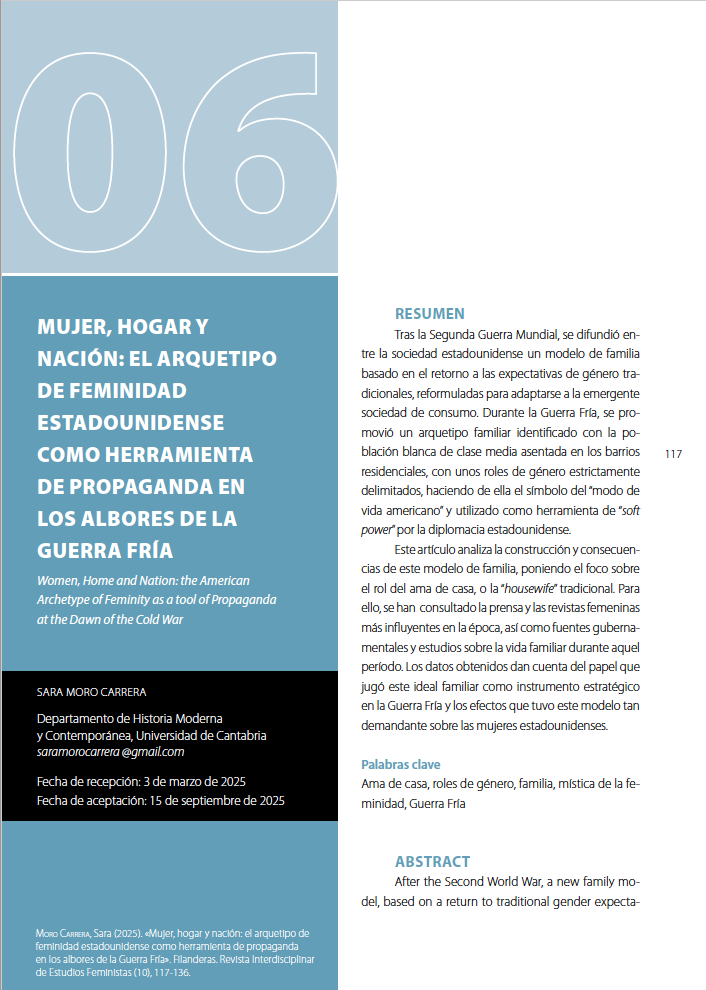
After the Second World War, a new family model, based on a return to traditional gender expectations, was reshaped to fit the emerging consumer society and became widespread in the American society. During the Cold War, the archetype of the white, middle-class suburban family, with strictly defined gender roles, was promoted as a symbol of the “American way of life” and used as a tool of “soft power” by US diplomacy.
This article analyses the construction and consequences of this family model, focusing on the role of the traditional housewife. To this end, I have examined the most influential women’s magazines and newspapers of that period, along with data from the Kelly Longitudinal Study, which documents married life between the 1930s and 1950s. The findings reveal how this family ideal functioned as a strategic instrument during the Cold War and the impact this demanding model had on American women.
Downloads
Downloads
Published
Issue
Section
License
Copyright (c) 2025 Sara Carrera

This work is licensed under a Creative Commons Attribution-NonCommercial 4.0 International License.
Authors who publish in this journal agree to the following terms:
They retain authorship rights and grant the journal the right to be the first publication of the work as well as license it under a Creative Commons Attribution-BY-NonCommercial 4.0 International that allows others to share the work without any commercial purpose and an acknowledgement of authorship of the work and initial publication in this journal. As the Creative Commons standards define, "this license enables reusers to distribute, remix, adapt, and build upon the material in any medium or format for noncommercial purposes only, and only so long as attribution is given to the creator. CC BY-NC includes the following elements:
- BY: credit must be given to the creator.
- NC: Only noncommercial uses of the work are permitted".