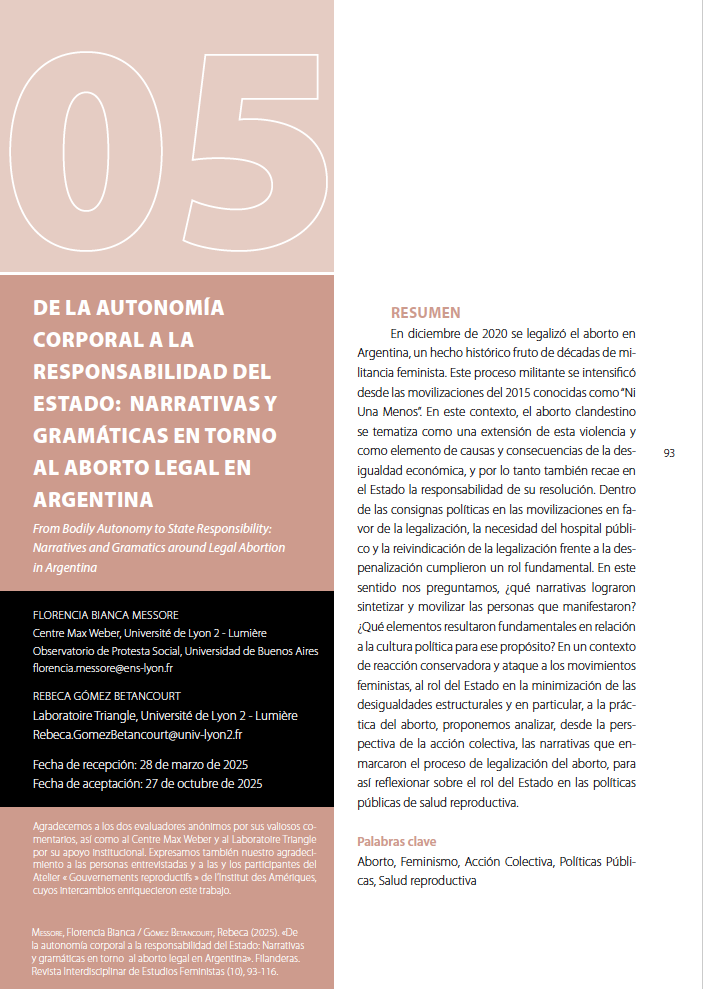
From Bodily Autonomy to State Responsibility: Narratives and Gramatics around Legal Abortion in Argentina
DOI:
https://doi.org/10.26754/ojs_filanderas/fil.20251011695Keywords:
abortion, feminism, collective action, public policy, reproductive health, argentinaAbstract
In December 2020, abortion was legalized in Argentina, a historic event resulting from decades of feminist activism. This militant process intensified since the 2015 protests known as "Ni Una Menos" (Not One Less). In this context, clandestine abortion is thematized as an extension of this violence and as a cause and consequence of economic inequality, and therefore the responsibility for its resolution also falls on the State. Among the political slogans of the protests in favor of legalization, the need for public hospitals and the demand for legalization or decriminalization played a fundamental role. In this sense, we ask ourselves, what narratives did the protesters manage to synthesize and mobilize? What elements in relation to political culture were fundamental for this purpose? In a context of conservative backlash and attacks on feminist movements, the role of the State in minimizing structural inequalities, and, in particular, the practice of abortion, we propose analyzing, from the perspective of collective action, the narratives that framed the process of legalizing abortion, in order to reflect on the role of the State in public reproductive health policies.
Downloads
Downloads
Published
Issue
Section
License
Copyright (c) 2025 Florencia Messore, Rebeca Gomez Bentacourt

This work is licensed under a Creative Commons Attribution-NonCommercial 4.0 International License.
Authors who publish in this journal agree to the following terms:
They retain authorship rights and grant the journal the right to be the first publication of the work as well as license it under a Creative Commons Attribution-BY-NonCommercial 4.0 International that allows others to share the work without any commercial purpose and an acknowledgement of authorship of the work and initial publication in this journal. As the Creative Commons standards define, "this license enables reusers to distribute, remix, adapt, and build upon the material in any medium or format for noncommercial purposes only, and only so long as attribution is given to the creator. CC BY-NC includes the following elements:
- BY: credit must be given to the creator.
- NC: Only noncommercial uses of the work are permitted".