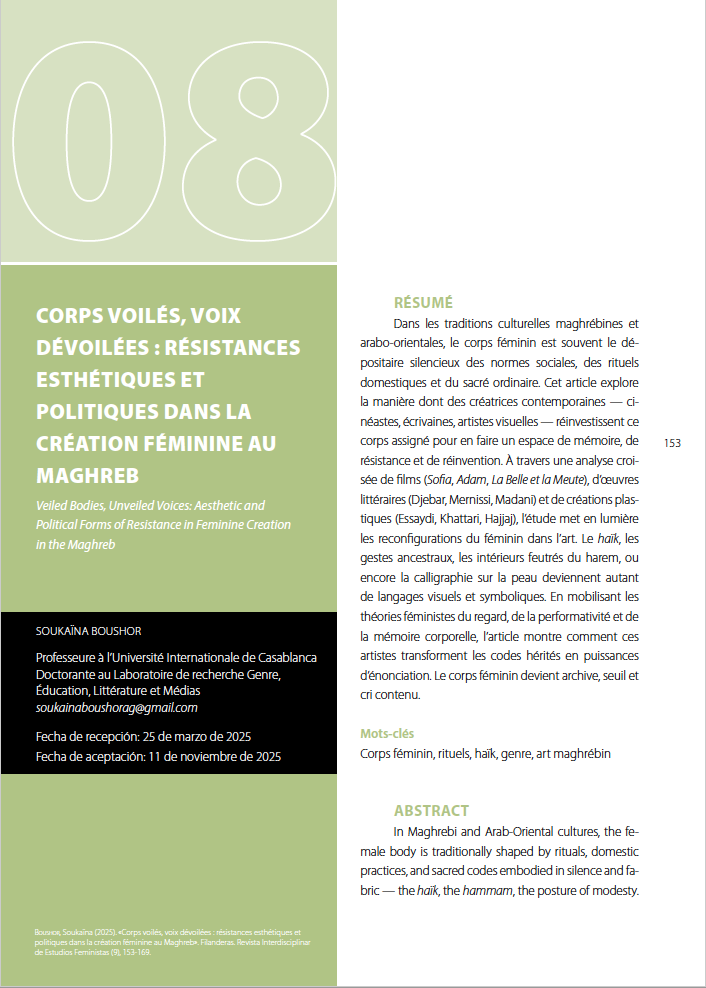
Veiled Bodies, Unveiled Voices: Aesthetic and Political Resistances in Women's Creative Expression in the Maghreb
DOI:
https://doi.org/10.26754/ojs_filanderas/fil.20251011687Keywords:
female body, rituals, haïk, gender, Maghrebi artAbstract
In Maghrebi and Oriental cultures, the female body is traditionally shaped by rituals, domestic practices, and sacred codes embodied in silence and fabric — the haïk, the hammam, the posture of modesty. This article explores how contemporary women artists—filmmakers, writers, visual creators—reclaim this culturally inscribed body and transform it into a space of memory, resistance, and expression. Through an interdisciplinary reading of films (Sofia, Adam, Beauty and the Dogs), literary works (Djebar, Mernissi, Madani), and visual pieces (Essaydi, Khattari, Hajjaj), the study highlights new aesthetic strategies that emerge from within tradition. Veiling, food preparation, female sorority, and bodily calligraphy become tools of subversion. Drawing on feminist theories of the gaze, performativity, and embodied memory, the article reveals how these works articulate alternative ways of seeing and being. The female body becomes a palimpsest of rituals, an archive of resistance, and a poetic site of rewriting.
Downloads
Downloads
Published
Issue
Section
License
Copyright (c) 2025 Boushor Soukaïna

This work is licensed under a Creative Commons Attribution-NonCommercial 4.0 International License.
Authors who publish in this journal agree to the following terms:
They retain authorship rights and grant the journal the right to be the first publication of the work as well as license it under a Creative Commons Attribution-BY-NonCommercial 4.0 International that allows others to share the work without any commercial purpose and an acknowledgement of authorship of the work and initial publication in this journal. As the Creative Commons standards define, "this license enables reusers to distribute, remix, adapt, and build upon the material in any medium or format for noncommercial purposes only, and only so long as attribution is given to the creator. CC BY-NC includes the following elements:
- BY: credit must be given to the creator.
- NC: Only noncommercial uses of the work are permitted".