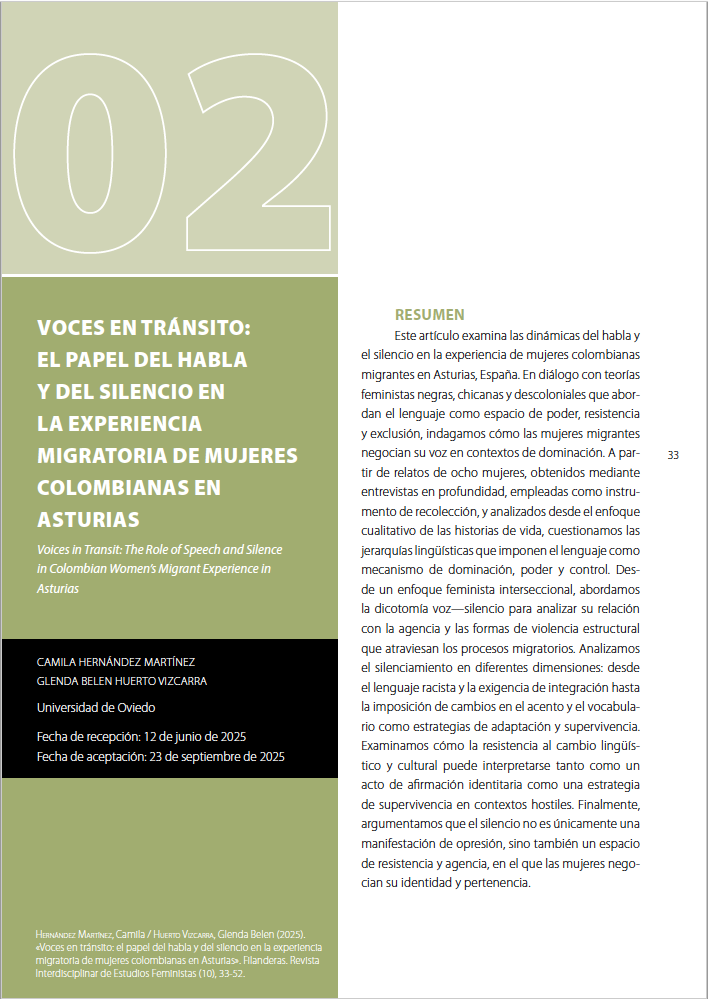
Voices in Transit: The Role of Speech and Silence in Colombian Women’s Migrant Experience in Asturias
DOI:
https://doi.org/10.26754/ojs_filanderas/fil.20251011727Keywords:
Migrations, gender, speech, silence, violenceAbstract
This article examines the dynamics of speech and silence in the experiences of Colombian migrant women in Asturias, Spain. Engaging with Black, Chicana, and Decolonial feminist theories that conceptualize language as a site of power, resistance, and exclusion, we explore how migrant women negotiate their voice in contexts of domination. Based on in-depth interviews with eight women, we question the linguistic hierarchies that position language as a mechanism of control, power, and domination. From an intersectional feminist perspective, we address the voice–silence dichotomy to explore its relationship to agency and the forms of structural violence that shape migratory processes. We analyze the mechanism of silencing across multiple dimensions: from racist language and demands for integration to the imposition of accent and changes in the vocabulary as strategies for adaptation as well as survival. We also consider how resisting linguistic and cultural change can function both as an act of identity affirmation and as a survival strategy in hostile environments. Finally, we argue that silence is not only a manifestation of oppression, but also a space of resistance and agency through which women renegotiate their identity and belonging.
Downloads
Downloads
Published
Issue
Section
License
Copyright (c) 2025 Camila Hernández Martínez, Glenda Belen Huerto Vizcarra

This work is licensed under a Creative Commons Attribution-NonCommercial 4.0 International License.
Authors who publish in this journal agree to the following terms:
They retain authorship rights and grant the journal the right to be the first publication of the work as well as license it under a Creative Commons Attribution-BY-NonCommercial 4.0 International that allows others to share the work without any commercial purpose and an acknowledgement of authorship of the work and initial publication in this journal. As the Creative Commons standards define, "this license enables reusers to distribute, remix, adapt, and build upon the material in any medium or format for noncommercial purposes only, and only so long as attribution is given to the creator. CC BY-NC includes the following elements:
- BY: credit must be given to the creator.
- NC: Only noncommercial uses of the work are permitted".