
Open Space Design Towards Resilient Territories: The Case of El Maresme (Barcelona) as a Laboratory for a Teaching Experience
DOI:
https://doi.org/10.26754/ojs_zarch/zarch.20252511769Keywords:
Public space, Open space, Landscape dynamics, Metropolitan environments, Water management, TeachingAbstract
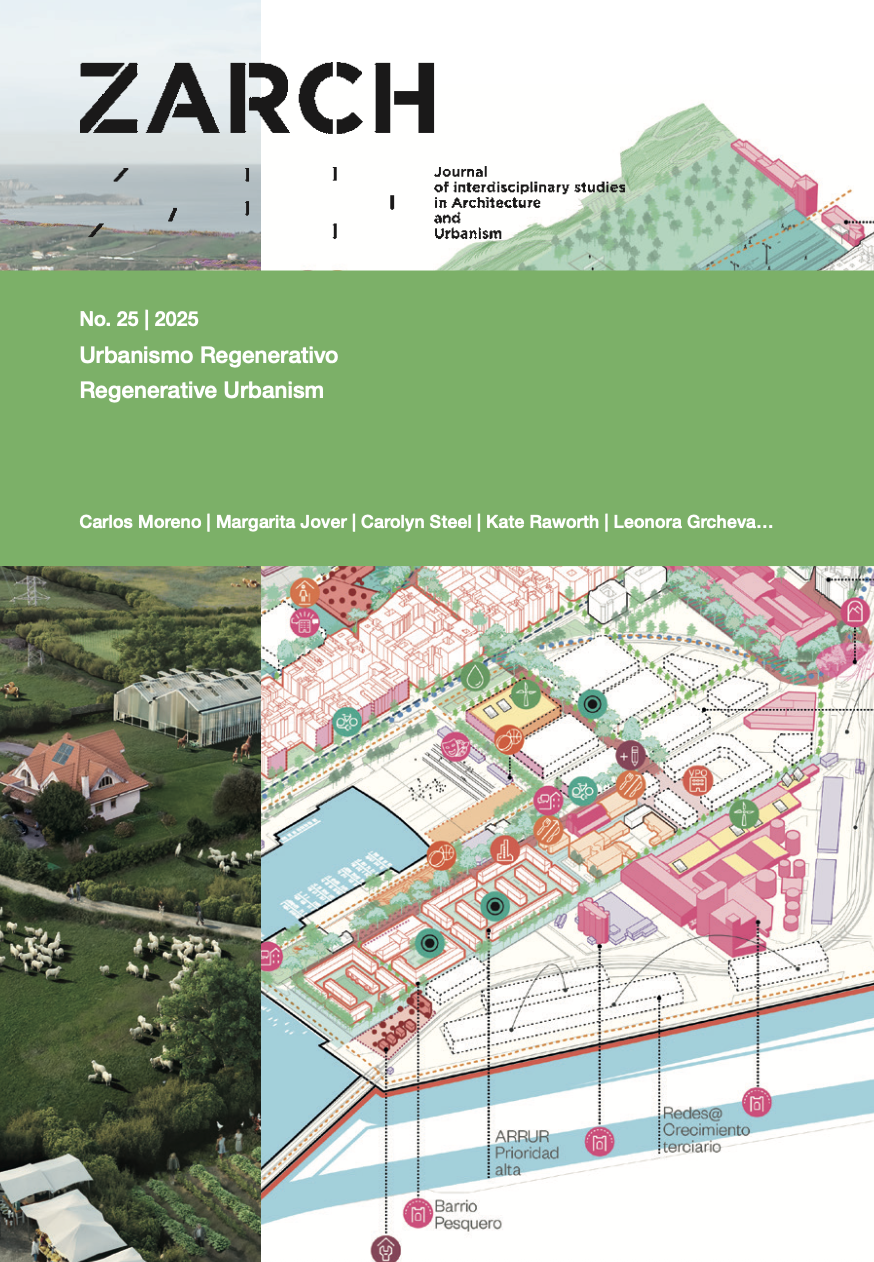
This article presents the pedagogical approach and results of a design studio focused on public space and landscape, conducted with fifth-year architecture students during the first semester of the 2024–2025 academic year at the School of Architecture of the City. The Maresme region (Barcelona) was used as a living laboratory—an area characterized by fragmented urbanization interspersed with open spaces of diverse socio-ecological value. Within this context, the student projects aimed to mitigate certain inefficiencies of the urban fabric while enhancing the environmental values of unbuilt land. The DANA storm that devastated Valencia served as a disruptive event, heightening awareness of the risks associated with flash floods—risks that also affect the Maresme territory. This event inspired an alternative perspective on water: not merely as a threat to be swiftly drained, but as a resource to be wisely managed. Many of the proposals were guided by this shift, exploring themes such as design as the starting point of evolving ecological processes, the compatibility between urban functionality and active natural systems, and other reflections discussed throughout the article.
Downloads
References
Adam, Barbara. Timescapes of Modernity: The Environment and Invisible Hazards. Londres: Routledge, 1998.
Ballesteros, C.; Jiménez, J.A.; Valdemoro, H.I., et al. Erosion Consequences on Beach Functions along the Maresme Coast. Natural Hazards 90 (2018): 173–95. DOI: https://doi.org/10.1007/s11069-017-3038-5
Benne, Beatrice y Mang, Pamela. Working regeneratively across scales: Insights from nature applied to the built environament. Journal of Cleaner Production 109 (2015): 44-52. DOI: https://doi.org/10.1016/j.jclepro.2015.02.037
Corner, James. Terra Fluxus. En Waldheim, C. ed. The Landscape Urbanism Reader, 21-34. Nueva York: Princeton Architectural Press, 2006.
Dwyre, Cathryn; Perry, Chris; Salomon, David y Velikov, Kathy ed. Ambiguous Territory: Architecture, Landscape and the Postnatural. Barcelona: Actar Publishers, 2022.
Garcia Ureta, Carles. Anàlisi Del Transport Públic Del Maresme I Propostes de Millora. Proyecto Final de Máster Oficial. UPC, ETSECCP, Barcelona, 2024.
Gehl, Jan. La humanización del espacio urbano. Barcelona: Ed. Reverté, 2006.
Korstanje, Maximiliano. Cómo funciona el riesgo en democracia: Política y sistema productivo. Eikasia: Revista de Filosofía (2014): 139-58. DOI: https://doi.org/10.57027/eikasia.55.758
Lyle, John Tillman. Regenerative Design for Sustainable Development. Nueva York: John Wiley & Sons, 1994.
Lynch, Kevin. The Image of the City. Cambridge, MA: MIT Press, 1960.
Margalef, Ramon. Teoría de los sistemas ecológicos. Barcelona: Publicacions de la Universitat de Barcelona, 1991.
McHarg, Ian L. Design with Nature. Nueva York: Natural History Press, 1969.
Olson, James D.; Forman, Richard T. T. y Dramstad, Wenche E. Landscape Ecology Principles in Landscape Architecture and Land-Use Planning. Washington D.C.: Island Press, 1996.
Wachinger, Gisela et al. The Risk Perception Paradox: Implications for Governance and Communication of Natural Hazards. Risk Analysis 33 (junio 2013): 1049–65. DOI: https://doi.org/10.1111/j.1539-6924.2012.01942.x
Downloads
Published
Issue
Section
License
Copyright (c) 2025 Joan Florit-Femenias, Pepa Morán Nuñez, Mónica Tárrega Klein

This work is licensed under a Creative Commons Attribution-NonCommercial-NoDerivatives 4.0 International License.