
Regenerative Urbanism in Spain
DOI:
https://doi.org/10.26754/ojs_zarch/zarch.20252512458Keywords:
Regenerative urbanism, Deliberation forums, Territorial reconquest, Climate adaptation, Climate mitigation, Climate regenerationAbstract
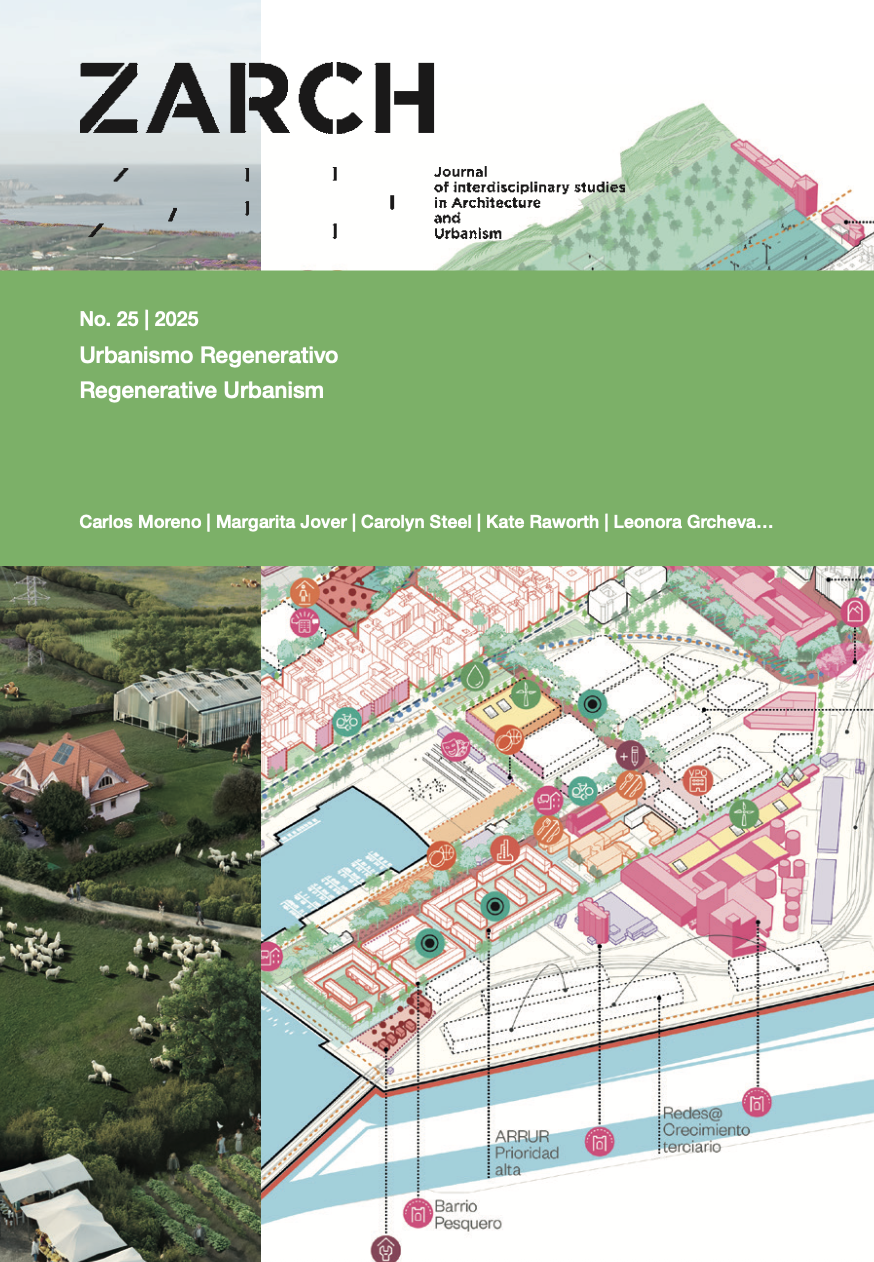
In the context of the desertification of the Iberian Peninsula resulting from climate change, an economic boom is serving as an historic opportunity to implement a multidisciplinary deliberative forum capable of coming to agreement regarding a Spanish Regenerative Territorial and Urban Model (MUTRE) that is set for implementation before 2100. The MUTRE would serve as a legal framework for promoting and financing strategic projects involving adaptation, mitigation and regeneration, both in the contexts of Spanish compact cities and of the empty territory of Spain. For compact cities, known adaptation, mitigation and regeneration strategies are proposed. For the empty territory, land reconquest strategies and ways of inhabiting that are better aligned with local resources are speculated. Positioning water and energy cycles as the focus, regenerative strategic projects could be critical of mass tourism, water engineering systems, intensive and irrigation agriculture, and modern infrastructures such as water treatment plants, desalination plants, data centres and large-scale renewables.
Downloads
References
Alberti, Marina. Cities that think like planets. Complexity, resilience, and innovation in hybrid ecosystems. University of Washington Press, 2016. DOI: https://doi.org/10.1515/9780295806600
Asher, François. Los nuevos principios del urbanismo. El fin de las ciudades no está a la orden del día. Alianza editorial, 2001.
Bonneuil, Christophe; Fressoz, Jean-Baptiste. The shock of the Anthropocene: the earth, history and us. Verso Publisher, 2017.
Charbonnier, Pierre. Affluence and freedom. An environmental History of Political Ideas. Polity Press, 2021.
Crutzen, Paul J. ‘Geology of Mankind’, Nature, 415, 3 January 2002: 23. DOI: https://doi.org/10.1038/415023a
De Terán, Fernando (2024) Atlas histórico del Urbanismo español, Fundación Arquia Publisher.
García García, Miriam. Díaz Rodríguez, Pilar Paisaje Transversal + Landlab-Laboratorio de paisajes. Urbanismo Regenerativo. Santander Hábitat Futuro. ACTAR, 2024.
Geddes, Patrick. Cities in evolution: an introduction to the town planning movement and to the study of civics. William & Norgate, 1915.
Klein, Naomi. This changes everything. Capitalism versus the climate. Simon & Schuster, 2014.
Marshall, Tim. El poder de la geografía. Diez mapas que revelan el futuro de nuestro mundo. Londres: Elliott y Thompson, 2021.
McHarg, Ian L. Design with nature. Wiley publisher, 1969; Geddes, Patrick. Cities in evolution: an introduction to the town planning movement and to the study of civics. William & Norgate, 1915.
Purdy, Jedediah. After Nature. A politics for the Anthropocene. Harvard University Press, 2002.Wrigley, E.A. Energy and the English Industrial Revolution. Cambridge University Press, 2010.
Raworth, Kate. The doughnut economics. Seven ways to think like a 21st-century economist. Random House, 2017.
Smil, Vaclav. The earth’s biosphere: evolution, dynamics and change, Cambridge, MA: MIT Press, 2002. DOI: https://doi.org/10.7551/mitpress/2551.001.0001
Swyngedouw, Erik. Liquid power. Contested hydro-modernities in twentieth-century Spain. London, England: MIT Press, 2015. DOI: https://doi.org/10.7551/mitpress/9780262029032.001.0001
Wrigley, Edward Anthony. Energy and the English Industrial Revolution. Cambridge University Press, 2010. DOI: https://doi.org/10.1017/CBO9780511779619
Downloads
Published
Issue
Section
License
Copyright (c) 2025 Margarita Jover

This work is licensed under a Creative Commons Attribution-NonCommercial-NoDerivatives 4.0 International License.