
Urbanismo regenerativo y proximidad: diseñando ciudades para las personas
DOI:
https://doi.org/10.26754/ojs_zarch/zarch.20252512457Palabras clave:
Urbanismo Regenerativo, Ciudad de los 15 minutos, Brownfields, Entropía urbana, TopofiliaResumen
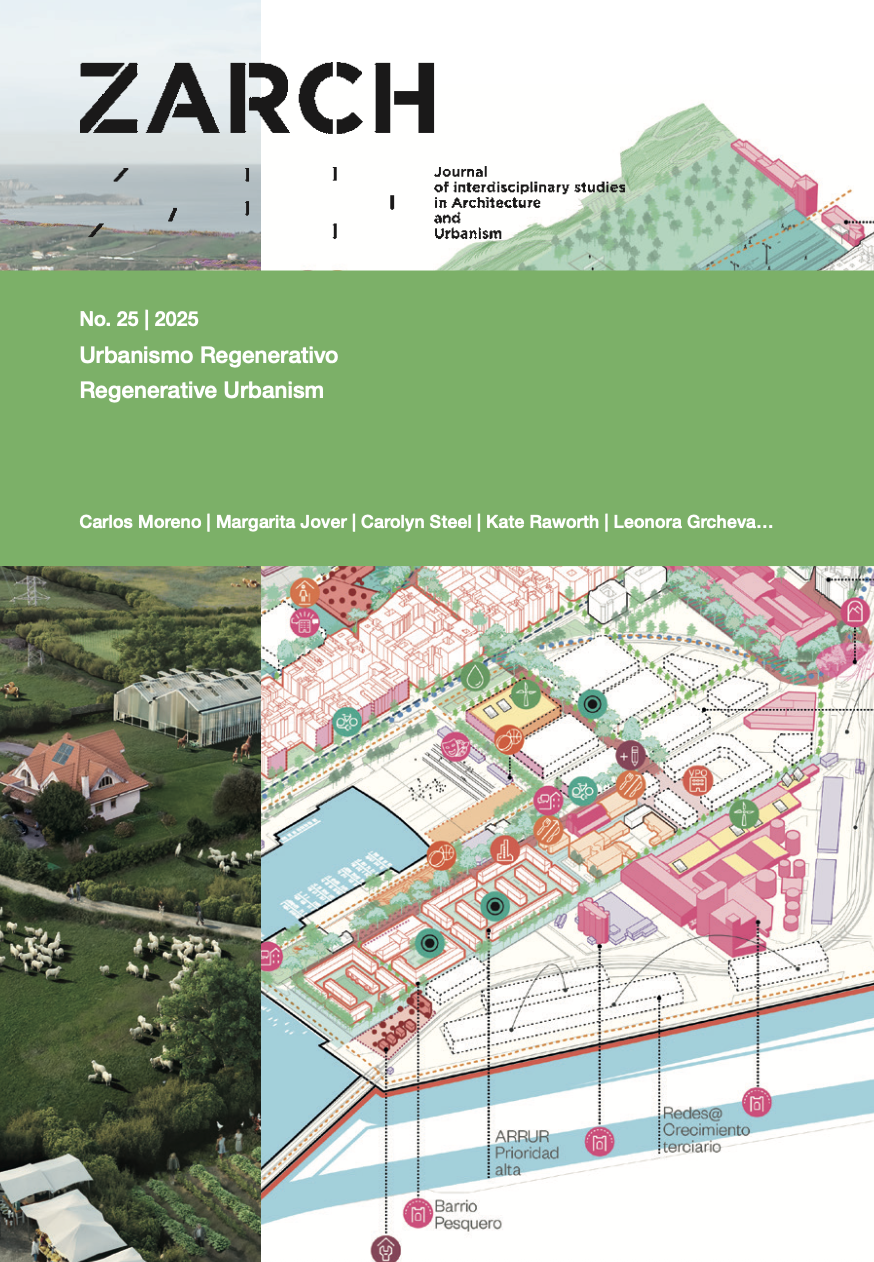
El artículo se plantea como presentación general del número 25 de la revista ZARCH dedicado al Urbanismo Regenerativo. Se revisan en el las principales aportaciones teóricas que configuran el marco teórico que redefine el propósito del urbanismo contemporáneo: no basta con minimizar el daño urbano, sino que es necesario regenerar la vida en todas sus dimensiones —ecológica, social, cultural y espiritual—, situando la ciudad como un agente activo de regeneración planetaria. Se repasan distintos apartados que tienen especial consideración en este campo, como el valor público y bien común; la transformación de la ciudad existente y la oportunidad de los “brownfields”; o la entropía urbana y reequilibrio socioambiental, por ejemplo. La conexión entre el concepto Urbanismo Regenerativo y el enfoque de la ‘Ciudad de los 15 minutos’ se analiza detenidamente, encontrando relaciones evidentes cuando se considera que la proximidad no puede alcanzarse sin regeneración previa. A modo de conclusión, el artículo culmina con un ‘Manifiesto por una ciudad próxima, justa y culturalmente viva”.
Descargas
Referencias
Abram, David. The spell of the sensuous: Perception and language in a more-than-human world. Vintage Books, 1997.
Ahern, Jack. From fail-safe to safe-to-fail: Sustainability and resilience in the new urban world. Landscape and Urban Planning, 100(4), 2011, 341–343. https://doi.org/10.1016/j.landurbplan.2011.02.021 DOI: https://doi.org/10.1016/j.landurbplan.2011.02.021
Andrade-Serrano, Oriana Yenahi, Polyanna O. Costa Santos, Ricardo V. Rodrigues Barbosa y Gabriel Castañeda-Nolasco. «Del interés sustentable al regenerativo: consideraciones a partir de proyectos premiados de vivienda multifamiliar», en Revista de Arquitectura (Bogotá), 26(1), 2024, pp. 107-124 https://doi.org/10.14718/RevArq.2024.26.4546 DOI: https://doi.org/10.14718/RevArq.2024.26.4546
Anguelovski, Isabelle, James J. T. Connolly, Laia Masip y Hamil Pearsall. Assessing green gentrification in historically disenfranchised neighborhoods: A longitudinal and spatial analysis of Barcelona. Urban Geography, 39(3), 2018, 458–491. DOI: https://doi.org/10.1080/02723638.2017.1349987
Beatley, Tim. Biophilic cities: Integrating nature into urban design and planning. Island Press, 2010. DOI: https://doi.org/10.5822/978-1-59726-986-5_4
Benedict, Mark. A., Edward T. McMahon, E. T. Green infrastructure: Linking landscapes and communities. Island Press, 2006.
Benediktsson, Karl y Katrín Anna Lund. Conversations with landscape. London, Routledge, 2011.
Benyus, Janine M. Biomimicry: Innovation inspired by nature. Harper Perennial, 1998.
Capra, Fritjof y Pier Luigi Luisi. The systems view of life: A unifying vision. Cambridge University Press, 2014. DOI: https://doi.org/10.1017/CBO9780511895555
García-Lamarca, Melissa, James J. T. Connolly, e Isabelle Anguelovski. Green gentrification and displacement in Barcelona. In Guy Baeten, Carina Listerborn, Maria Persdotter, & Emill Pull (Eds.), Housing Displacement: Conceptual and Methodological Issues, p. 156–70, Routledge, 2020. DOI: https://doi.org/10.4324/9780429427046-11
Gehl, Jan. Ciudades para la gente (1ªed.). Infinito, 2014.
Ingold, Tim. Being alive: Essays on movement, knowledge and description. Routledge, 2011.
Lefebvre, Henri. El derecho a la ciudad (E. Martínez, Trans.). Capitán Swing, (Libro original publicado en 1968), 2009.
Logan, Tom M., Matthew H. Hobbs, Lindsey C. Conrow, N. L. Reid, R. A.Young, & Mitchell J. Anderson. The x-minute city: Measuring the 10, 15, 20-minute city and an evaluation of its use for sustainable urban design. Cities, 123, 2022, 103566. https://doi.org/10.1016/j.cities.2022.103566 DOI: https://doi.org/10.1016/j.cities.2022.103924
Mang, Pamela y Ben Haggard, Regenesis. Regenerative Development and Design: A Framework for Evolving Sustainability. Wiley, 2016. DOI: https://doi.org/10.1002/9781119149699
Mang, Pamela y Bill Reed. Regenerative Development and Design. Encyclopedia of Sustainability Science and Technology. Springer, 2012. DOI: https://doi.org/10.1007/978-1-4419-0851-3_303
Maturana, Humberto R. y Francisco Varela G. El árbol del conocimiento: Las bases biológicas del entendimiento humano. Editorial Debate, 1990.
Moore, Mark H. Creating public value: Strategic management in government. Harvard University Press, 1995
Morales Roche, Paula. Ciudad de los 15 minutos, Revisitando el modelo de Clarence Perry, Trabajo de grado, Fundamentos de l’arquitectura, Universidad de Alicante, 2024.
Moreno, Carlos, Zaheer Allam, Didier Chabaud, Catherine Gall y Florent Pratlong. Introducing the “15-minute city”: Sustainability, resilience and place identity in future post-pandemic cities. Smart Cities, 4(1), 2021, 93–111. https://doi.org/10.3390/smartcities4010006 DOI: https://doi.org/10.3390/smartcities4010006
Moreno, Carlos. La revolución de la proximidad, de la ciudad mundo a la ciudad de 15 minutos. Alianza Editorial, 2023. DOI: https://doi.org/10.3917/s.ldt.ladra.2022.01.0231
Moreno, Carlos. The 15-Minute City: A Solution for Saving Our Time and Our Planet. Wiley, 2024. DOI: https://doi.org/10.1002/9781394308774
Morin, Edgar. Introducción al pensamiento complejo. Barcelona: Editorial Gedisa, 2005.
Næss, Arne. Ecology of wisdom: Writings by Arne Naess. Counterpoint, 2008.
Ostrom, Elinor. Governing the commons: The evolution of institutions for collective action. Cambridge University Press, 1990. DOI: https://doi.org/10.1017/CBO9780511807763
Oswalt, Philipp, Klaus Overmeyer, y Philipp Misselwitz. Urban catalyst: The power of temporary use. DOM Publishers, 2013.
Reed, Bill. Shifting from ‘sustainability’ to regeneration. Building Research & Information, 35(6), 2007, 674-680. DOI: https://doi.org/10.1080/09613210701475753
Relph, Edward. Place and placelessness. Pion, 1976.
Sanford, Carol. The regenerative business: Redesign work, cultivate human potential, achieve extraordinary outcomes. Nicholas Brealey, 2017.
Scannell, Leila y Robert Gifford. Defining place attachment: A tripartite organizing framework. Journal of Environmental Psychology, 30(1), 2010, 1–10. https://doi.org/10.1016/j.jenvp.2009.09.006 DOI: https://doi.org/10.1016/j.jenvp.2009.09.006
Secchi, Bernard. La città dei ricchi e la città dei poveri. Laterza, 2013.
Shannon, Kelly y Marcel Smets (Eds.). The Landscape of Contemporary Infrastructure. Rotterdam: NAi Publishers, 2010/2016.
Tuan, Yi-Fu. Topophilia: A study of environmental perception, attitudes, and values. Englewood Cliffs, NJ: Prentice-Hall, 1974.
Wahl, Daniel Christian. Designing regenerative cultures. Triarchy Press, 2016.
Wolch, Jennifer R., Jason Byrne, y Joshua P. Newell. Urban green space, public health, and environmental justice: The challenge of making cities ‘just green enough’. Landscape and Urban Planning, 125, 2014, 234–244. https://doi.org/10.1016/j.landurbplan.2014.01.017 DOI: https://doi.org/10.1016/j.landurbplan.2014.01.017
Descargas
Publicado
Número
Sección
Licencia
Derechos de autor 2025 Carlos Moreno

Esta obra está bajo una licencia internacional Creative Commons Atribución-NoComercial-SinDerivadas 4.0.