
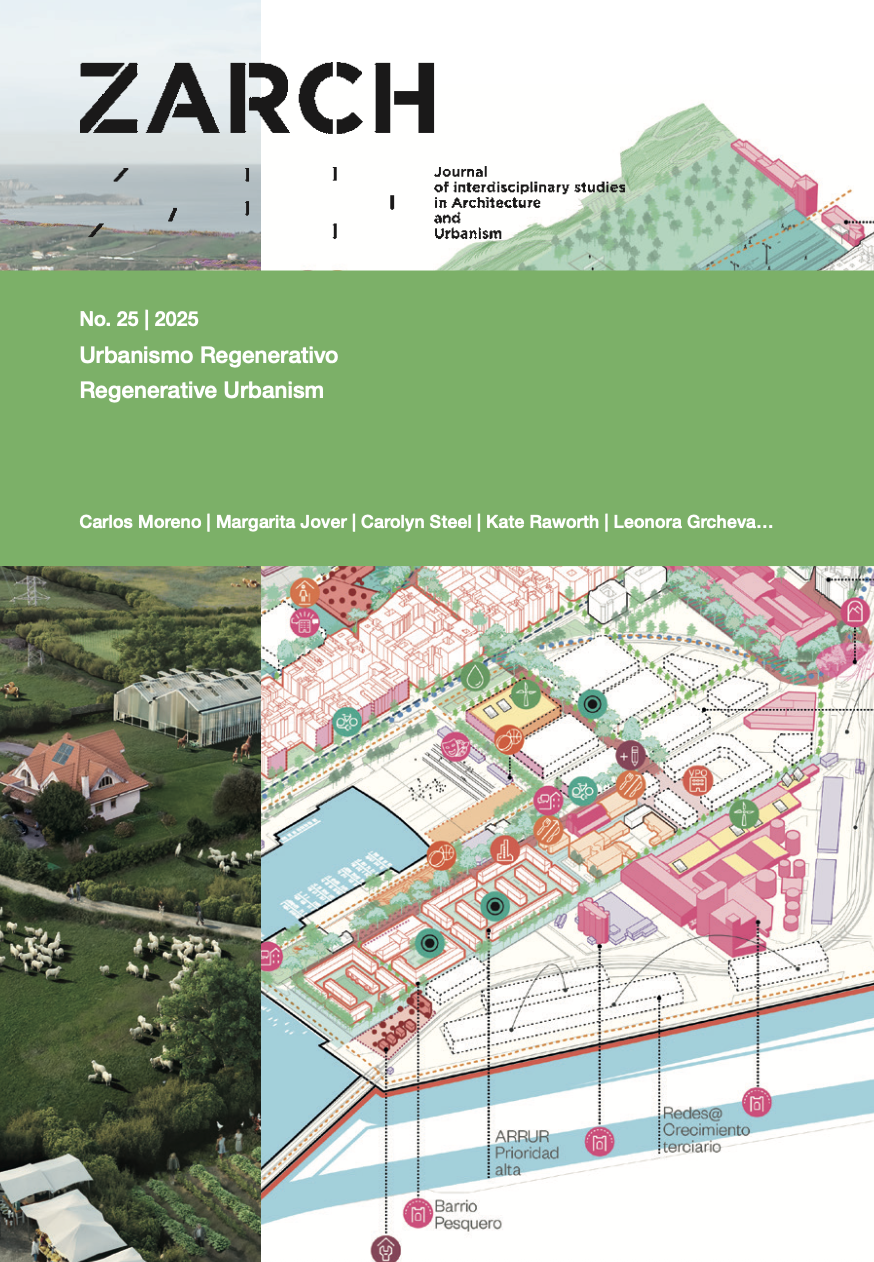
Regenerative Urbanism

Authors

DOI:

https://doi.org/10.26754/ojs_zarch/zarch.20252512454

Keywords:

Regenerative urbanism, Urban resilience, Ecosystem sustainability, Inclusive and proximity-based city, Ecological transition and decarbonisation

Abstract

The text addresses the profound environmental and social crises generated by the extractive urban model that emerged from the Industrial Revolution, which has produced highly unsustainable cities and exceeded the planet’s regenerative capacity. Contemporary urbanism, largely focused on productivity and technological innovation, has often neglected domestic, social and ecological dimensions, resulting in fragmented, car-dependent and socially unequal urban fabrics. In this context of global systemic crisis, existing urban planning tools are insufficient to respond to interconnected challenges such as climate change, resource scarcity and social inequality. The text proposes regenerative urbanism as a necessary paradigm shift that goes beyond sustainability, aiming not only to reduce impacts but to actively repair and revitalize urban ecosystems. Rooted in ecological thinking and traditions of cooperation and mutual aid, regenerative urbanism emphasizes symbiosis between human and non-human systems, resilience, biodiversity and adaptive capacity. It draws on historical and contemporary practices that prioritize human-scale environments, active mobility, inclusive neighborhoods, circular economies and efficient management of water, energy and materials. The call invites critical, historical and applied contributions that explore regenerative strategies across scales, from public space to territorial planning, as well as methodologies, governance models and educational experiences capable of shaping a resilient and cooperative urban future.

Downloads
Download data is not yet available.

Author Biographies

  • Miriam García, Landlab, laboratorio de paisajes, Polytechnic University of Catalonia

    PhD Architect, landscape architect, and urban planner, she is a founding partner of LANDLAB, laboratorio de paisajes. Her research and professional practice view landscape and ecology as drivers of transformation in plans and projects across multiple scales. Her work focuses on the resilience of coastal, urban, and metropolitan environments in the face of climate change, integrating analysis, design, and strategic planning to create adaptive and sustainable territories.
    She is the author of numerous scientific articles and actively participates in research projects and socio-ecological activism. She is a member of the Scientific Committee of Europan Europe and a senior affiliated researcher at the Institute of Environmental Hydraulics at the University of Cantabria, focusing on climate, energy, and marine infrastructure. Currently, she is a professor in the Department of Urbanism, Territory, and Landscape at UPC, combining research, teaching, and professional practice to promote transdisciplinary approaches that link design, ecology, and urban policy in response to climate challenges.

  • Jon Aguirre-Such, University of the Basque Country

    Jon Aguirre Such is an architect and urban planner from the Polytechnic University of Madrid, specialising in Planning and Sustainability. With over 15 years of professional experience, he has worked with public administrations at all levels — from local to European — on projects related to integrated sustainable urban development, territorial planning, multi-stakeholder governance, and climate change. He was a founding partner of the planning consultancy Paisaje Transversal until 2025, served as the Spanish National URBACT Point (2017–2023), and acted as a national expert for the EU Smart Rural 21 programme (2020–2022). From 2022 to 2025, he was a professor of Urban Planning at the University of the Basque Country (EHU), and has been a guest lecturer in master's programmes at several Spanish and international universities. He is co-author of numerous specialised publications, including Listening to and Transforming the City (2018), Integrated Urban Planning: Learning from Europe (2020), and Regenerative Urbanism (2023).

  • Iñaki Romero-Larrea, Paisaje Transversal, Polytechnic University of Valencia

    Architect and urban planner educated at the Polytechnic University of Madrid and a founding partner of Paisaje Transversal, an integrated urban planning practice from which he works to improve cities and territories through a scientific and more democratic approach. His career combines professional practice, research, and teaching, driven by a deep passion for understanding and transforming the contemporary city. He specializes in integrated planning, regeneration of historic centers and neighborhoods, sustainable mobility, and spatial data analysis and visualization. He has studied and worked in Germany and Peru, and has collaborated since the beginning of his career with leading figures of Spanish urbanism such as Ramón López de Lucio. He is currently an Associate Professor at the Polytechnic University of Valencia and has previously taught at the European University of Valencia. He has published and delivered numerous outreach articles and lectures, and is the co-author of key reference books in Spanish urbanism such as Listening and Transforming the City and Regenerative Urbanism.

  • Pablo de la Cal, University of Zaragoza

    Pablo de la Cal Nicolás (Zaragoza, 1964) is an architect (University of Navarra, 1989) and holds a Master of Architecture in Urban Design (Graduate School of Design, Harvard University, 1992). He holds a PhD from the University of Valladolid with a thesis entitled ‘Zaragoza: urban construction in a territory of rivers and orchards. River dynamics, hydraulic infrastructure and the city’. He is currently a contracted professor at the School of Engineering and Architecture at the University of Zaragoza. He is actively involved in research and has contributed to numerous books and specialist journals. Of particular note is his book Ríos y Ciudades. Aportaciones para la recuperación de las riberas de Zaragoza (Rivers and Cities. Contributions to the recovery of the banks of Zaragoza), 2002, coordinated together with geographer Francisco Pellicer. His recent research focuses on urban regeneration from an ecological perspective and in fields such as urban agriculture, green infrastructure and urban resilience.

Downloads

Published

2025-12-23

How to Cite

García, M., Aguirre-Such, J., Romero-Larrea, I., & de la Cal, P. (2025). Regenerative Urbanism. ZARCH. Journal of Interdisciplinary Studies in Architecture and Urbanism, 25, 4-11. https://doi.org/10.26754/ojs_zarch/zarch.20252512454

Most read articles by the same author(s)