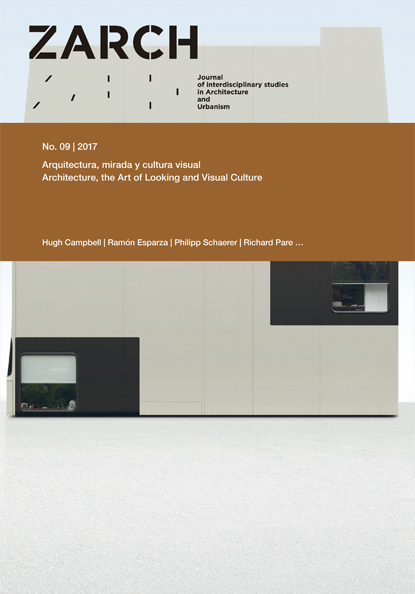
Horizonte cóncavo. Jan Dibbets y la percepción de la arquitectura
DOI:
https://doi.org/10.26754/ojs_zarch/zarch.201792268Palabras clave:
Fotografía, Percepción, Espacio, Vacío, Horizonte, DibbetsResumen
Ante la arquitectura, metáfora que media entre lo inmenso y lo íntimo, somos seres sensoriales completos, no únicamente organismos visuales. Hay una tensión continua entre la realidad de su construcción material y tectónica, y la dimensión abstracta, idealizada y espiritual de su imaginario artístico. Del mismo modo, la fotografía de un espacio construido contiene dos interiores: el interior de la imagen y el del propio espectador. Todas las imágenes, objetos visuales, son sentidas como experiencia interior, que alcanza con su eco hasta la dimensión pública y plural. Hay una transferencia de emociones e ideas, tan fundamental como malentendida en el arte contemporáneo. La comunicación de esa dualidad es analizada en la obra fotográfica de Jan Dibbets: la tensión entre la visión central y la periférica, la multiplicidad de la perspectiva, la intelectualización de la línea recta, las secuencias de lecturas, las intersecciones del magnetismo de la belleza… Puesto que es producto de la tensión activa entre percepción y representación, el vacío se genera entre un punto central -enfatizado como constructor de la imagen y no como ubicación física del sujeto- y el arco donde se suceden las secuencias de lo visible. Es la distancia que separa irremediablemente experiencia y naturaleza física. Un horizonte cóncavo tensionado por la dispersión y la gravedad del orden circular, entre lo reconocido y lo intuido.
Descargas
Referencias
Arnheim, Rudolf. 1998. El pensamiento visual. Barcelona: Paidós.
Aumont, Jacques. 1997. El ojo interminable. Barcelona: Paidós.
_____. 2002. La imagen. Barcelona: Paidós.
Andreotti, Libero, dir. 2011. Spielraum: Walter Benjamin et l’architecture. Paris: Éditions de La Villette.
Berger, John. 1997. Algunos pasos hacia una pequeña teoría de lo visible. Madrid: Árdora Ediciones.
_____. 2006. El sentido de la vista. Madrid: Alianza Forma.
Colomina, Beatriz. 2010. “Los medios de comunicación como arquitectura moderna”, Exit 37, Arquitectura II. La mirada del artista: 112-139.
Debord, Guy. 2009. La sociedad del espectáculo. Valencia: Pretextos.
Dibbets, Jan. 2005. Saenredam – Zadkine. Paris: Éditions Paris-Musées.
Fontcuberta, Joan, ed. 2008. ¿Soñarán los androides con cámaras fotográficas? Madrid: Ministerio de Cultura.
Fried, Michael. 2007. Contre la théâtralité. Du minimalisme à la photographie contemporaine. Paris: Gallimard.
Fuchs, Rudi y Moure, Gloria. 1991. Jan Dibbets. Luz interior. Obras sobre arquitectura. 1969-1990. Barcelona: Polígrafa.
Maderuelo, Javier (comisario exposición). 2008. La construcción del paisaje contemporáneo. Huesca: CDAN, Fundación Beulas.
Marchán Fiz, Simón. 1981. Del arte conceptual al arte del concepto. Madrid: Akal.
Merleau-Ponty, Maurice. 1964. Le visible et l’invisible. Paris: Gallimard.
Nougé, Paul. 1956. Histoire de ne pas rire. Bruxelles: Les Lèvres Nues.
Puelles Romero, Luis. 2011. Mirar al que mira. Teoría estética y sujeto espectador. Madrid: Abada Editores.
Rousse, Georges. 2009. Georges Rousse. Paris: Actes Sud.
Verhagen, Eric y Dibbets, Jan. 2007. L’oeuvre photographique 1967-2007. Paris: Éditions du Panama.
Verhagen, Eric. 2012. “The Horizon according to Jan Dibbets : an Endless Quest”, Depth of Field, volume 2, nº 1.